
LOS ALAMITOS, Calif. — Rather than starting a new unit, creating a music video covering course topics, or doing mindless busywork after their Advanced Placement test like many other AP classes, Los Alamitos High School AP Chemistry students spend two weeks inspiring awe in Los Alamitos Unified School District fifth-grade students.
How it Works:
After giving students a few days to decompress from the three-hour-long grueling national exam, LAHS Chemistry teacher, Mr. Jones, spends a few short days teaching his AP students the simple experiments they’ll be conducting with the younger kids, and then the two class periods spend two weeks as mentors and instructors. These simple science experiments are meant to pique the interest of the fifth graders and cultivate a love for science, strengthening their intellectual curiosity.
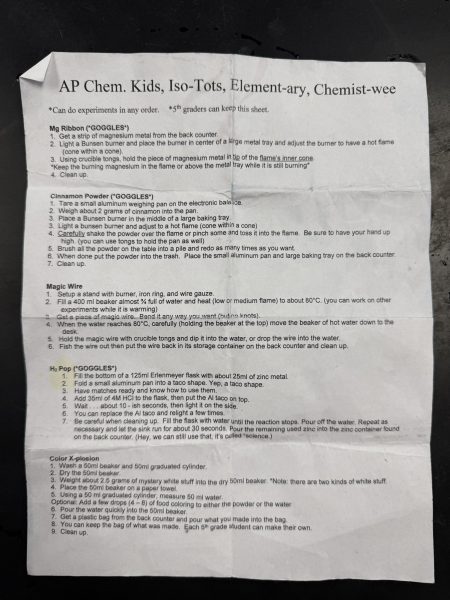
Roughly two to three AP students pair up with a handful of the visiting fifth graders, working with a new class from one of the district’s five elementary schools each day. The AP students — and the fifth graders — get the chance to don a lab coat and googles, mimicking a stereotypical scientist, and work their way through a series of potions and explosions led by the AP students. The experiments range in both technical and chemical complexity, including everything from fake snow to Hydrogen peroxide.
How it Came to be:
“It started before me. The AP Chemistry teacher before me, [Mrs. Catherine Curry], did a one day thing… with one fifth-grade class… And then, in my first year of AP Chem, I reached out to the fifth-grade teacher who had done it before and said, hey, do you want to do this again? And she said, yes. So we did,” said Mr. Jones.
The original two teachers, Mrs. Catherine Curry, who taught AP Chemistry at LAHS, and Mrs. Lisa McClellan, who taught fifth grade at McGaugh Elementary School, were the originators of this brilliant exploration of mentorship and intellectual curiosity. Then, through word of mouth and teacher talk, the collaboration spread from one class at one elementary school to an entire school the next year; eventually, the entire district was participating in the field trip annually.
“It took about a good four or five years to get to where it was every school. It’s probably been about 10 years that we’ve done every school,” said Mr. Jones, in regard to the growth process of the program.
In his nearly 30 years at LAHS, Mr. Jones has facilitated this tradition for as long as he has taught AP Chemistry, beginning in 2012. Mr. Jones explained that, unless there’s a scheduling conflict between the timing of the AP Chemistry class periods and the availability of the fifth-grade classes, every fifth grader within LAUSD is able to experience this magic each year.
How it feels (the impact):
Both the AP Chemistry students and the elementary schoolers feel that their relationship with STEM and their interaction with their education have been enriched by this experience.
“With multiple elementary schools, it shows us how different they interact,” said LAHS sophomore Leah Tran.
“It’s pretty funny, we’ve got some nice instructors…there’s a lot of fire,” said fifth-grade Los Alamitos Elementary student James Aragon. While words may not have fully expressed James’ wonder, his face says it all (pictured right).

“We get to share our interest in science with kids and kind of influence them. I hope this is what will… create a foundation for them to continue science,” said Allison Kim, a sophomore at LAHS, reflecting on this opportunity and successfully fulfilling Mr. Jones’s hope for his students.

“It made me appreciate teachers because it made me realize that some of these kids are kind of a lot … but it’s also very fun,” said Canon La, a tenth grader at LAHS, a week into the experience, learning the type of unintentional lessons that shape LAHS Griffins. And while Mr. Jones acknowledges the extent of the request made of these students, he also explains the importance of the experience for both parties and the “why” behind it all.
The “Why”:
“I think this is one of the most important things I do all year. The idea is, let’s get younger kids exposed first to the high school. Second, to science. And then, they’re inspired, they’re interested, and then, hopefully, that motivates them,” said Mr. Jones.
In stark contrast to the course content of most other AP courses at LAHS, the only other activity AP Students participate in after the AP exam is Mr. Jones’ optional “Kitchen Chemistry,” which consists of students bringing kitchen supplies and ingredients to their AP Chemistry class period to cook up a breakfast during class.
“You’ve earned it. If you have survived AP Chem, you have gone through two years of AP Chem, basically,” said Mr. Jones, when asked who made this decision and how.
In order to even qualify for enrollment in AP Chemistry, students must first take honors chemistry and get teacher approval and a qualifying grade in the class. Typically, students on this pathway will take honors chemistry their freshman year instead of biology so that they may take AP Chemistry their sophomore year. This means that, for most students enrolled in the course, it’s the hardest class they have taken at that point in their high school career, a hugely impactful component of Mr. Jones’ approach to the course.
“I figure you’ve earned the right to just relax, have a little fun.. And then the fifth-grade thing, although I think it is really important, it’s a burden.. So that’s why I figure after surviving two years of…high level chemistry…then having to essentially become the mentor teacher with the fifth grader, if you get a day off, you’ve earned it,” said Mr. Jones.
He emphasizes that, now more than ever, this mental break is critical to students’ success, especially with the volume of students he sees overcommitted each year and the intensity of their day-to-day lives.