

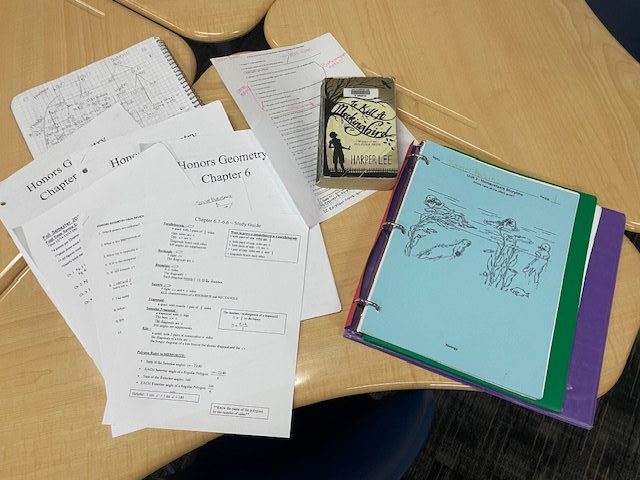
LOS ALAMITOS, Calif. – Finals are coming up and the impending exam season can often create stress and pressure on students. Many procrastinate due to a heavy workload and then panic, which leads them to perform poorly on their exams. However, there are ways to prevent this from happening.
According to Cornell University, one of the eight Ivy League universities famous for its efficient note-taking strategy called Cornell Notes, one recommended strategy includes interleaving.
Interleaving is a study technique that allows students to get multiple subjects done in one day instead of cramming one subject for hours on end separately. The objective is to pursue multiple related topics together. For example, studying English and history simultaneously and switching between both in twenty-minute intervals. This method strengthens a scholar’s recall of information and makes sure students stay caught up on all subjects.
Another common study tool is flashcards. This tool allows students to recognize which terms they understand and which ones they need to study more. While extensive studying with flashcards is time-consuming, creating short, fun sessions with vocabulary terms is one of the most effective strategies.
Cornell also suggests a strategy called Spaced Learning, which is when students spread out studying and take multiple breaks, improving their mood and productivity. It is more efficient in retaining information than long cramming sessions and is better for students’ mental health.
Another large contributor to performing well on exams is health. Finals season can be stressful, but it is essential not to sacrifice sleep, nutrition, hygiene or mental breaks in favor of cramming. A multitude of studies show that making time for proper breaks in studying and eating a good meal will help studying become less stressful and more effective in the long run.
“Don’t wait until like a couple (of) days before. You want to start at least two weeks before the final. You want to start it early enough so that you can identify where you are strong and where you’re weak and (then) you’ve got time to address the weaker parts,” said Mr. McKee, Los Alamitos High School geometry and algebra II trigonometry teacher.
A common piece of advice is to stay ahead of the game. Allowing yourself time to digest the information and not feel stressed right before the exam is the key to academic triumph.
“I always take (…) an eight and a half by 11 sheet of copy paper and I can fill it up front and back with things that I think are important,” said Mr. McKee. “It’s a good idea to go back through all your notes and then kind of summarize them.”
There are many benefits of going through notes, but the main advantage is that the information can move from short-term memory, which is what happens when people cram, to long-term memory, which is scientifically proven to be easier to access and remember over time.
“When football players are practicing the day before a game, it’s a light practice, right? They do all their heavy workouts (…) earlier in the week,” said Mr. McKee.
This analogy can apply to studying. Doing all the hard work sooner rather than later and then briefly reviewing before the exam is the best way to get optimal results.
“Half the problem with taking up a comprehensive test like that is being able to be confident. (Another) thing I was going to say is when you’re practicing problems, practice problems that you have solutions to, because it doesn’t really help you when you’re studying for a final to not know whether you’re getting the answer right (…) that’s going to help with the confidence,” said Mr. McKee.
According to a University of Notre Dame Class of 2025 graduate, Meaghan Northrup, time management is an essential skill to master when preparing for exams.
“Exams are not created equal (…) some exams, even if equally difficult, require different amounts of time. For example (…) if you have a 98% in one class and an 89% in another, that should factor into how you split your (studying) time. (…) Furthermore, different types of material require different timeframes,” wrote Northrup in Finals Week: Balancing Studying, Self-Care, and Sanity.
Additionally, she explained that essay-based exams don’t need as much time spent preparing in order to provide the desired results and can be studied closer to the exam date. In contrast, “sheer memorization of terms, ideas, and concepts requires repetition over several days or weeks,” so they can be properly secured in a person’s long-term memory and therefore perform well on the test.
Across all sources, the key ways to excel in final exams are to prepare in advance, prioritize health, use simple but effective strategies and go into the exams confident and stress-free.
Good luck on your finals, Griffins!