

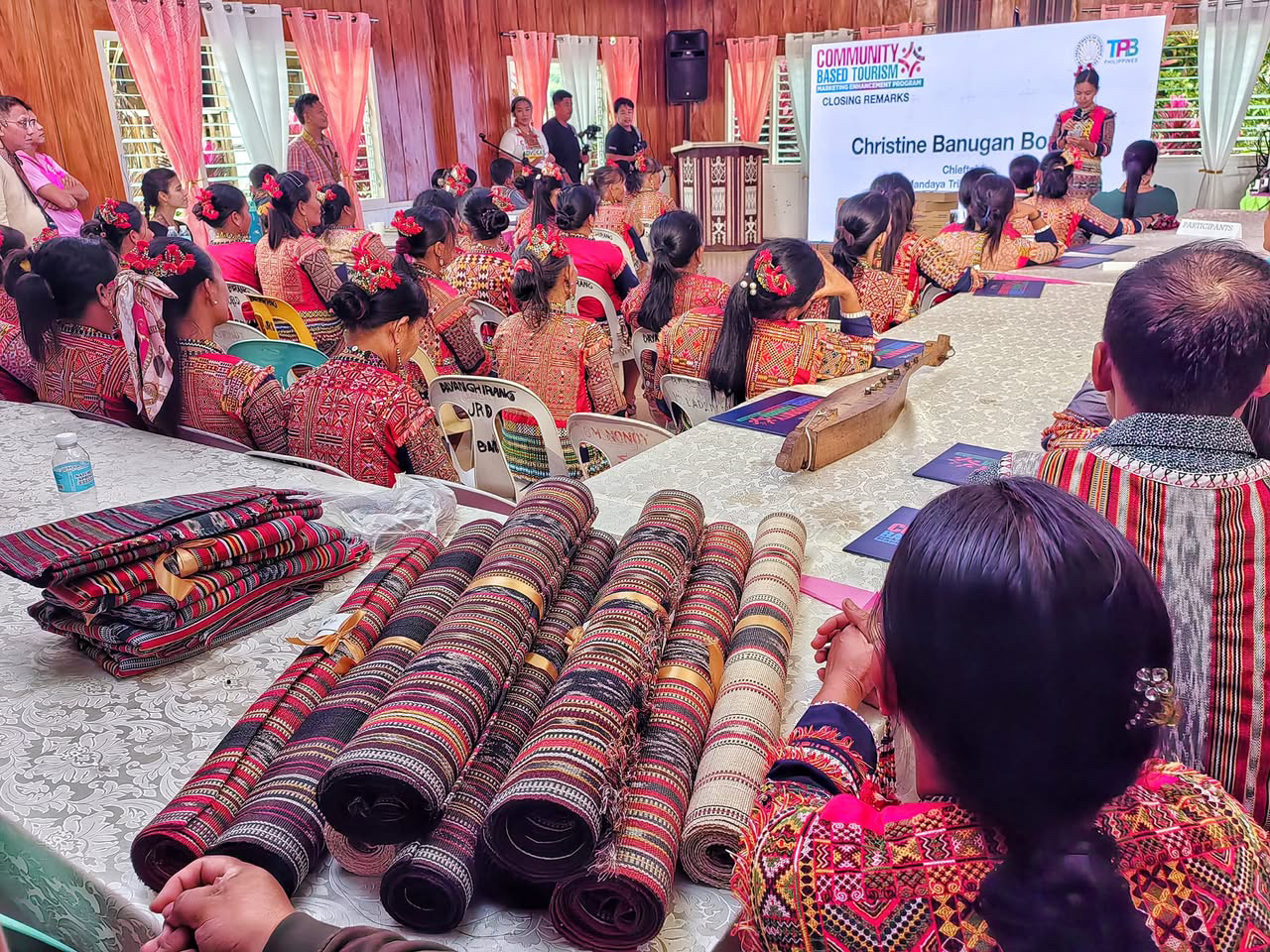


LOS ALAMITOS, Calif. — First, she harvests the abaca stalks, stripping the fibers to create threads. Then, she combs and prepares the fibers, boiling them with tree bark to create a dye. Finally, she sews the fibers together to make the fabric.
Mandaya member Samporonia Madanlo often repeats this process of sewing traditional Filipino, Dagmay, fabric. Madanlo is part of the Mandaya tribe, who reside in Caraga, Davao Oriental (Mandanao, Philippines). Weaving Dagmay fabric is an essential part of Mandaya culture for Mandaya women, who are known as magdadagmay.
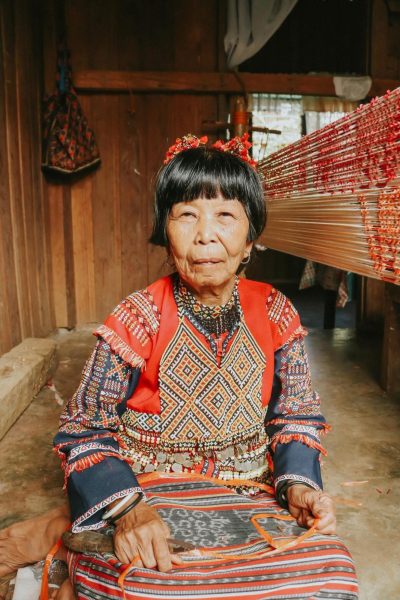
Mandalo is known as a gependaling, or master weaver, and she has been practicing making Dagmay since she was 10 years old. She is also skilled at beadwork, sewing and more. She is considered exceptionally skilled at crafting Dagmay fabric and won the National Living Treasure or GAMABA award for her weaves.
But Madanlo is not the only magdadagmay; she is part of a dying community of approximately 288,000 to 424,000 Mandaya members (Joshua Project estimates about 288,000 total Mandaya), who still participate in the tradition of creating Dagmay fabric.
But why does this tradition need to be preserved? Why is the Dagmay fabric significant?
Philippines-resident Ness Piamonte wants to help to spread awareness about the Dagmay fabric fading due to modernization attempts and lack of abaca (stalks used to create the threads). There are currently cultural organizations, schools and government efforts to restore the Dagmay fabric in Caraga by revitalizing the weaving tradition, increasing market access and encouraging young Mandaya women to learn weaving from their elders. However, there is currently a lack of awareness about this tragedy within the Filipino American community.
She first explained the history, materials, designs and tradition behind the Dagmay fabric.
She said that the Dagmay fabric is a traditional Mandaya (Filipino indigenous group) fabric, created using traditional methods, and represented by traditional, bold and geometric patterns. It was created in the Philippines during an unknown date (although Philippine Studies UK estimates that it started around 1913). Dagmay fabric originates from Filipino mythology (which Team Out of Town affirms), emphasizing the tale of the deity Tagamaling.
She also explained how the fabric is made.
“Abaca is a native fiber extracted from the banana-like abaca plant. The process is painstakingly and entirely manual – from stripping and drying the fibers to dyeing them with natural pigments derived from forest plants, roots and barks. Red dyes come from the sikalig plant, black and brown hues are made of tree roots and yellow tones come from tumeric. The fibers are hand dyed through the ikat process, where parts of the thread are tightly bound before dyeing to resist color, resulting in intricate, geometric patterns once woven,” said Piamonte.
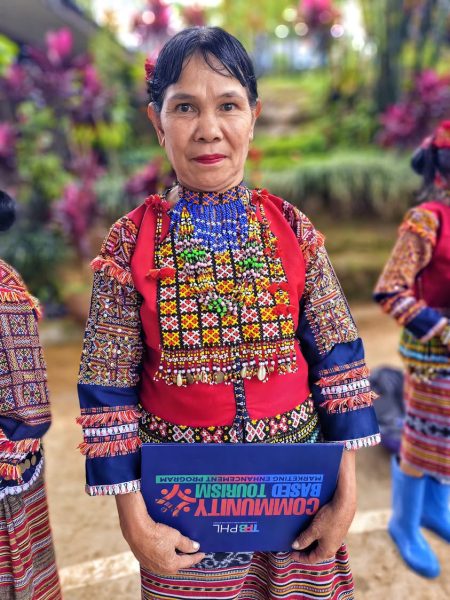
Piamonte also tells me the significance of the Dagmay designs. She explains that motifs, including human figures, lizards, eagles, crocodiles and sacred patterns, can symbolize protection, fertility and balance between seen and unseen worlds. Others can also protect the wearer from harm or represent one’s lineage or role in a community.
For most, it is a representation of ancestral memory and identity.
Dagmay cloths were traditionally used as garments, blankets and ritual offerings used from a wearer’s birth to their death.
“It is the Mandaya people’s woven memory, a reflection of their worldview, spirituality and resilience. Each piece tells a story of identity — one that must be remembered, preserved and passed on,” said Piamonte.
Within the history of the Dagmay fabric lies the culture of the Mandaya people.
Filipino traveler Marky Ramone Go also affirms the significance of the Dagmay fabric through a story he created on Dec. 8, 2024. Go, who visited Davao Oriental and talked to various magdadamay, including Samporonia Madanlo, says that the Mandaya are one of 11 ethnic groups in Davao, and affirms that Dagmay fabric is significant to Filipino culture due to its unique weaving process and cultural symbolism. He also emphasizes the significance of Madanlo due to her role as a Mandaya gipandayan and baylan (or a skilled craftsperson and shaman).
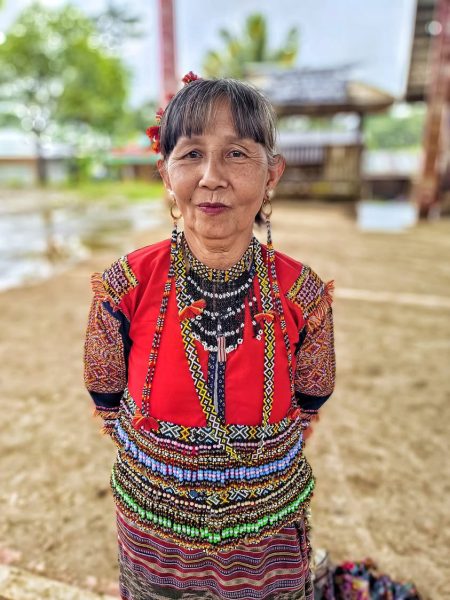
However, unlike Piamonte’s claims, Go claims that the magdadamay use a mud-dying process, rather than using natural dyes made from plants, roots and barks to make Dagmay.
But, similar to Piamonte he emphasizes the significance of young Mandaya in continuing this tradition.
“To help preserve and encourage the younger Mandaya generation to continue this traditional art form, it is paramount to let them know that preserving their culture can also go hand in hand with sustaining their community,” said Go.
Fabric maker and Los Alamitos High School science teacher Mrs. Merrell says that protecting the endangered fabric is essential to preserving the Mandaya culture.
“We should protect this fabric from becoming extinct…I am in a group where we dress up as fantasy figures, and I noticed how fabric can help form communities. Making fabric has helped me form relationships and find others’ stories and other cultures,” said Mrs. Merrell.
Mrs. Merrell also brings up important points about the significance of fabric for others.
“For many people, fabric represents stories and their culture. Losing this fabric can damage Mandaya culture and tradition,” said Mrs. Merrell.
Sewing, in general, can be a great way for people to express and educate themselves, as well as become involved with their community.
Los Alamitos Education Foundation (LAEF) has various programs in the Los Alamitos Unified School District (LAUSD) which emphasize sewing as a valuable hobby, including an After School Enrichment Program which teaches Crochet and Sewing to kids. Voyage LA wrote an article about LAHS Digital Art teacher Evenstarr Long, who talked about the significance of creating art, including sewing, in his and his students’ lives.
“I want (my students) to see that creating is not just a talent that people have or a job that you show up for. Creating is a thousand, thousand little moments of love for what you do. Something you do for yourself, and for others,” said Long in the article.
In addition, according to a Jan. 22, 2025 article published by Spotlight Schools, LAUSD’s McAuliffe Middle School drama teacher Renee Schwarz spent money granted from the Los Alamitos Education Foundation on a new sewing machine and 3D printer for her 100+ drama students. She hopes that sewing can help create costumes and props for creative works, such as plays.
She also emphasizes how fabric can help student engagement, learning, creativity and elicit celebration for their own work, while being a tool “for getting their ideas from paper to reality,” she said in a 2025 interview with Spotlight Schools’ Jeannette Andruss.
“These machines/tools will have a big impact on student learning as they will be able to see their visions and designs come to life, compared to the past, where we could only design on paper or online,” Schwarz said when applying for the LAEF money.
LAHS students, as well as teachers, predict that the Dagmay fabric’s disappearance will be detrimental to the Mandaya.
Hana Huynh, a member of the LAHS Asian American Appreciation club, as well as president of the LAHS Sewing Club, also emphasizes the significance of fabric on herself.
“I think the importance of fabric is making people feel good…because it’s custom…it’s so special because I get to see the hard work and hours on someone that I care about and love, and it’s a lot of fun making things for myself and knowing that I made it myself,” said Huynh.
Huynh, part of the Asian American community, also thinks that losing Asian culture can have debilitating effects on people in the Asian American community.


Katie Arnoult • Dec 12, 2025 at 9:09 am
I love this article, this is definitely Best of SNO material! I love how you tied it back to LAHS and how it’s affecting our school community.